Blood and Nerves and Dr.Tazo's Spiritual Science System

A Student Posed this Question:
Please illustrate blood in this dynamic?
"In Rudolf Steiner's anthroposophical teachings, **blood** plays a central, mediating role in relation to the **neurological gaps** (interruptions or breaks in the nerve pathways) that serve as **ports of entry** for spiritual influences and communication (e.g., subtle inspirations from the spiritual world, higher beings, or the dead).
Steiner describes the human being as consisting of four members: the physical body, aetheric (life) body, astral body, and ego ("I"-organization). These interact dynamically with the organism's systems:
- The **nervous system** is primarily the physical expression/instrument of the **astral body** (which carries soul impulses, desires, and sensations). Nerves tend toward materialization and "dying off"—they become more mineralized, rigid, and "dead" (excreted matter along nerve paths), enabling clear, antipathetic (separating, individuating) thinking and perception.
- The **blood** (and circulatory system) is the primary instrument/expression of the **ego** ("I"), with strong ties to the etheric body (life forces) and warmth element. Blood tends toward spiritualization—it wants to "whirl up as spirit" or become ever more ethereal if isolated from physical destruction (via breathing/exhalation). It retains and individualizes spiritual forces rather than letting them pass through unchecked.
The **gaps** (e.g., in the spinal cord where sensory nerves enter posteriorly and motor nerves exit anteriorly, or in sympathetic ganglia) are points where nerve activity is interrupted. At these breaks:
- Sympathy (attraction, connection to spiritual/will forces) and antipathy (repulsion, separation for individuality) interplay dynamically.
- They act as **ports** where spiritual influences can permeate from the supersensible into the physical, enabling freedom, consciousness, ethical impulses, and reciprocal exchanges (e.g., the dead influencing the living via inner promptings).
**Blood relates to these gaps** as the vital, mediating counter force:
- Blood "plays upon" or interacts with the nervous system at these interruption points, especially in the head (where blood-nerve interplay forms memory), chest (rhythmic breathing/circulation), and limbs/metabolic regions.
- The blood brings life, warmth, and ego-individuality into the otherwise "deadening" nerve processes, preventing the gaps from becoming purely material voids.
- Through circulation and breathing, blood integrates etheric vitality (oxygen uptake) and astral influences, modulating how spiritual forces enter via the gaps—balancing sympathy/antipathy so permeation is harmonious rather than overwhelming.
- Without blood's spiritualizing tendency, the gaps would lack the ego's anchoring force; with it, spiritual communications (e.g., inspirations during introspection or sleep) can flow subtly and ethically.
In key lectures (e.g., from *The Foundations of Human Experience* / GA 293 and *Fundamentals of Therapy* / GA 27 co-authored with Ita Wegman), Steiner states:
- "Blood wants to become ever more spiritual—nerve ever more material."
- At gaps, "sympathy and antipathy interplay," with blood as the "very special fluid" that retains spirit within the body while nerves allow permeation/transparency.
- Blood-nerve interaction (e.g., in the head for memory, or via sympathetic nerves) creates centers where spiritual forces "enter" without dominating materiality.
Disruptions (e.g., imbalances in blood processes or developmental issues) can distort this mediation, leading to uncontrolled spiritual influxes (as in schizophrenia interpretations discussed earlier).
This polarity—nerves materializing/deadening vs. blood spiritualizing/livening—is essential for human evolution: nerves provide structure for clear thinking; blood provides warmth/ego for spiritual connection via the gaps. The blood thus acts as a **mediator** or bridge, ensuring spiritual ports remain open yet balanced within earthly incarnation.
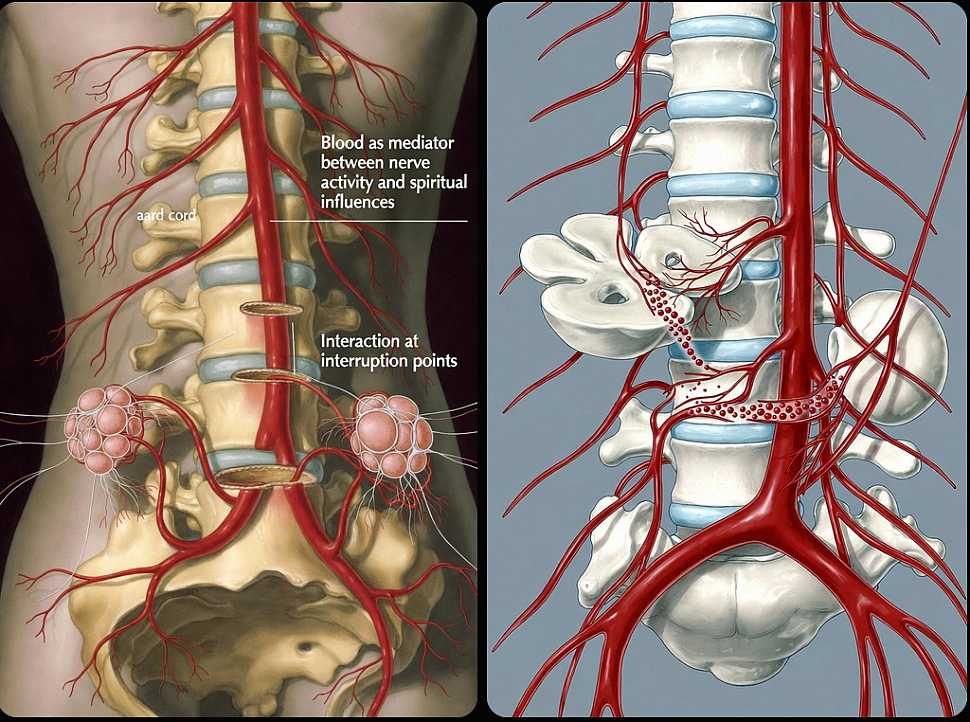
For visual reference, here are factual scientific-style illustrations approximating Steiner's described blood-nerve interplay and gaps (e.g., spinal cord interruptions where blood circulation interfaces with nerve pathways):
These depict anatomical transitions in the spinal cord and sympathetic system—locations Steiner linked to sympathy/antipathy dynamics and blood's mediating role in spiritual-physical boundaries."
0 comments
Add comment